

Jōdō
杖道道
All Japan Kendo Renmei - Seitei
全日本剣道連盟 - 制定
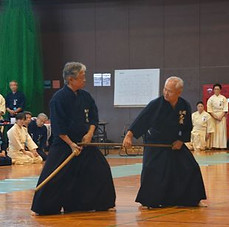
Jōdō is the study of the application of a 4 foot wooden staff using effective body positioning and techniques to defend against an attack from a sword and controlling the opponent in response to their movements.
Practise involves the study of Kihon (basic movements) both Tandoku (solo) and Sotai (paired) and then applying those Kata (prescribed forms) comprising both attack and defence movements.
Ongoing practice builds the skill and understanding needed to perform each Kata with precision and control. Through their study, practitioners develop an appreciation of the relationship between life and death, movement and stillness.

Seitei Jōdō origins & background
Jōdō has its origins in 17th century Japan with the founder, Musō Gonnosuke Katsuyoshi, a practitioner of Kasumi Shintō-ryū kenjutsu (sword) undertaking a period of reflection on Mount Hōman in Kyushu after his defeat by famous swordsman Miyamoto Musashi. It is said that during reflection he received a vision which led him to develop the Jō as a weapon (although it was never an effective battlefield weapon against fully armoured opponent).
Jōdō remained relatively unknown until the 20th century when it was transmitted throughout Japan, and more recently the world.
In 1952 the Zen Nihon Kendo Renmei (ZNKR), also known as the All Japan Kendo Federation, was founded Jōdō practise was added the the ZNKR. In 1968 Shimizu Takaji and a committee created the Seitei (standard) Jōdō syllabus:
-
12 Kihon Tandoku (solo fundamentals) which provide the shape of core techniques
-
12 Kihon Sotai (paired fundamentals) which provide an understanding of application of the core tecniques against an opponent.
-
12 Kata (pre-determined forms) which provide the mechanism for further study and transition of the mechanics and movements of Kihon into application.
Both the Kihon and Kata were derived primarily from Koryu Jōdō – the first 10 kata from the Omote, chudan and Ran’ai series of Shindō Musō-ryū as they were seen to best represent the art albeit with minor modifications to suit the ZNKR requirements. The two other kata were created specifically for the new Seitei Jōdō system.
Kunifumi Morimoto, Hanshi 8 Dan from Osaka Prefecture, the current ZNKR Jōdō Iinchō (Chair of the Jōdō Committee) provides the technical direction of the Kihon and Seitei Kata for the ZNKR and international affiliates. He succeeded Shiiya Mitsuo Sensei.
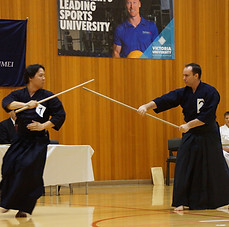
Seitei Jōdō training at Kuroyama Budokai.
Study of Seitei Jōdō at Kuroyama Budokai involves the learning of the progressive practise of the 12 Kihon and then the 12 Seitei Kata of the ZNKR. The technical guidance of these Kata is currently provided to Kuroyama Budokai senior practitioners by:
-
Shiiya Mitsuo, Hanshi 8th Dan from Tokyo Prefecture and former ZNKR Jōdō Iinchō - when they visit Japan to train privately or at several of the Dojos in the region that he oversees; and
-
Toshiyuki Otake, Hanshi 8th Dan from Kanagawa Prefecture - during annual visits to Australia.
Beginners usually take the role of Shidachi performing the techniques with a more senior partner performing the role of Uchidachi and controlling the level of training. Students still learn the Uchidachi movements which enable them in future sessions to support beginners.
Instructing Team.
Seitei Jōdō study at Kuroyama Budokai is lead by the following instructor cohort:
-
Damon Schearer - Renshi Rokudan (6th Dan)
-
Brendan Kee - Renshi Rokudan (6th Dan)
-
Andrew Thompson - Godan (5th Dan)
-
Lee Walsh - Yondan (3rd Dan)